
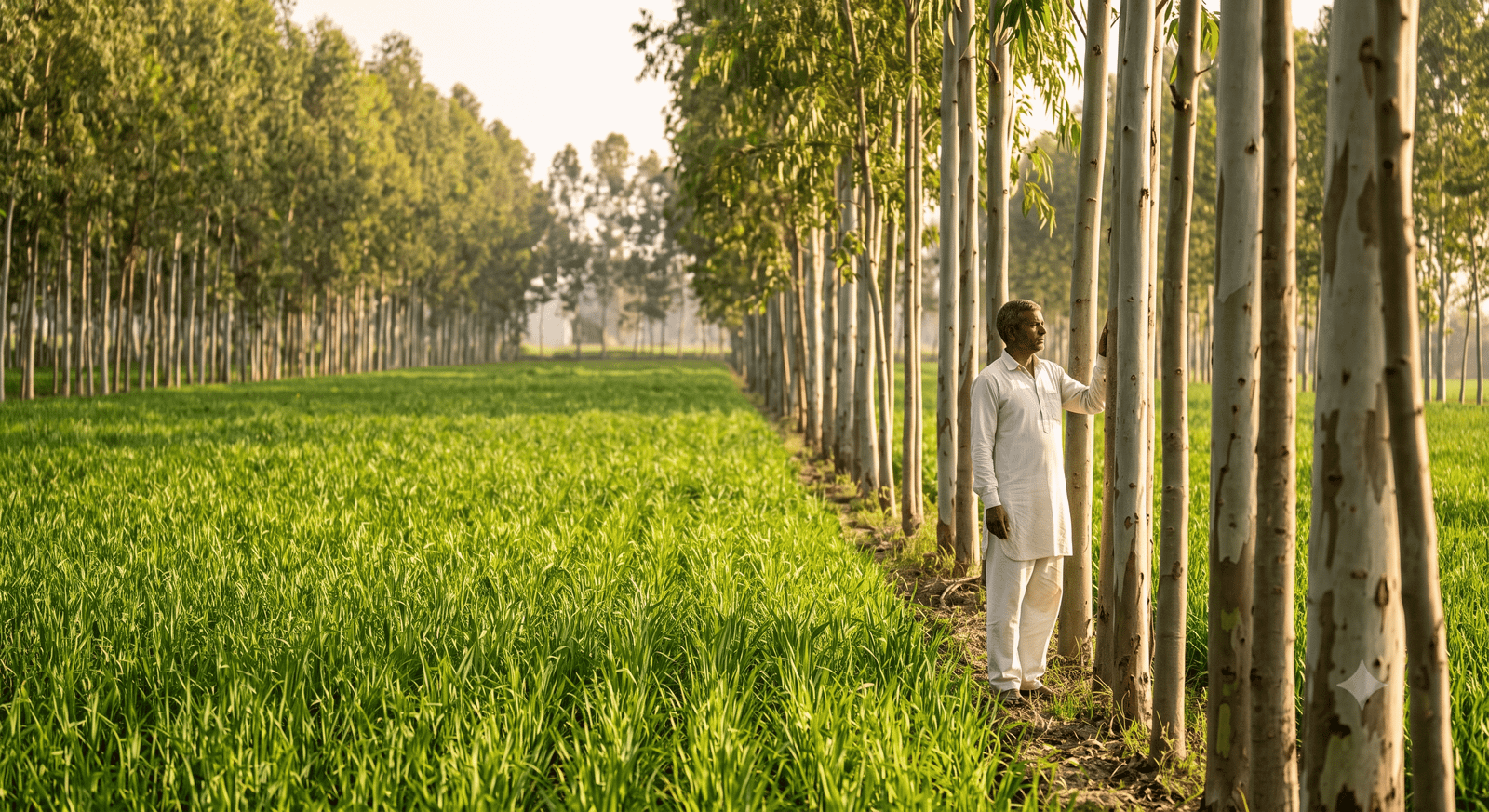
For generations, Indian farmers have planted trees on field boundaries for shade, fodder and firewood. Today those same trees can be a serious source of income. India's paper, plywood and panel industries need more wood every year, and most of it now comes from farms, not forests. A farmer who plants the right tree, in the right way, with an assured buyer, can turn idle or low-return land into a dependable asset.
At Prakritik India Initiative, we work with farmers to make this happen. Here is what farm forestry means, which trees work best, and how to get started.
Why trees on farms make sense now
India's forests cannot meet industry's demand for wood, and legal limits on felling natural forests are strict. As a result, mills increasingly depend on trees grown outside forests. According to the Central Agroforestry Research Institute, cited in a 2024 EAC-PM working paper, agroforestry already supplies about 60 per cent of the raw material for India's paper and pulp industry.
That demand is your opportunity. Unlike many seasonal crops, a pulpwood plantation:
• Needs less water, labour and fertiliser once established
• Is less affected by a single bad monsoon or price crash at the mandi
• Can be grown alongside regular crops in the early years
• Improves soil organic matter through leaf litter and root systems
• Gives a lump-sum income at harvest, useful for big family expenses
The three trees that matter most
Eucalyptus. Clonal eucalyptus is the backbone of India's pulpwood supply. Good clones grow fast and straight, and are usually harvested in about four to six years. After the first cut, the stump re-sprouts (coppices), so you can get a second rotation without replanting. It suits a wide range of soils but needs proper spacing and should not be planted on waterlogged land.
Poplar. Poplar is the favourite tree of farmers in the Terai and the plains of north-western India. It is deciduous, so it sheds leaves in winter and lets sunlight reach crops like wheat below. Poplar is usually harvested in six to eight years and is valued by both plywood and paper industries.
Melia dubia (Malabar neem). A newer favourite, Melia dubia is very fast-growing and adaptable. It is used for pulpwood, plywood and light timber. Farmers in many states are trying it as an alternative or complement to eucalyptus.
The right choice depends on your soil, rainfall, irrigation, and which mills are within economic distance of your village. Transport cost can make or break profit, so planting near a buyer matters.
Growing trees and crops together
Farm forestry does not mean giving up your regular crops. In the first two or three years, before the canopy closes, you can grow crops between tree rows. Common intercrops include wheat, pulses, vegetables, turmeric and ginger, depending on the region. With poplar, many farmers continue winter crops for the full rotation.
There are two main planting patterns:
• Block plantation: trees across a full plot, with intercrops in the early years
• Boundary or bund planting: one or two rows along field edges, so the main field stays under regular crops
Boundary planting is a good way to start if you are new to tree farming.
What makes a plantation succeed
Most failures in farm forestry come from a few avoidable mistakes. Keep these in mind:
1. Use quality planting material. Buy certified clones or seedlings from a trusted nursery. Poor stock is the most common reason for low yields.
2. Plan your spacing. Spacing affects tree growth, intercropping and machine access. Wider spacing suits intercropping; closer spacing suits pure pulpwood.
3. Protect young plants. The first year is critical. Watch for termites, weeds and grazing animals.
4. Know the rules. Felling and transit rules for farm-grown trees vary by state. Many states have relaxed rules for species like eucalyptus and poplar, but check before you plant.
5. Secure a buyer early. A buy-back arrangement or a link to a mill's sourcing programme gives you price confidence at harvest.
6. Keep records. Note where and when you planted, what you planted and what you used. These records are becoming important for sustainability certification and export rules.
Why records and traceability now matter
Paper buyers in India and abroad are asking a new question: where exactly did this wood come from? Rules like the European Union's deforestation regulation and voluntary standards like FSC certification require proof that wood was grown legally and not on cleared forest land.
For farmers, this is good news. Wood with clean records and a known origin is easier to sell and can earn better terms. Simple steps today, such as keeping land documents ready and recording your plot location, can open doors to these buyers tomorrow.
How Prakritik India can help
Prakritik India Initiative works between farmers and the pulp and paper industry. We help farmers:
• Choose suitable species and planting material for their land
• Plan plantations, intercropping and care
• Connect with responsible buyers, including major paper mills
• Keep the records needed for traceable, certified supply chains
Our aim is simple: more trees on farms, fairer income for farmers, and a sustainable supply of wood for industry.
Thinking of planting trees on your land? Contact us to talk to our team about farm forestry in your area.